Showing posts with label book. Show all posts

Tuesday, September 8, 2026

"Nightmares and Daydreams: A.C. 2020" in London bookstores

I am pleased to announce that my book Nightmares and Daydreams: A.C. 2020, published by SelfMadeHero, with a foreword by Steven Heller and an afterword by Dave McKean, went on sale last Friday, September 5th, in London bookstores.
Here are a couple of photos from Forbidden Planet in 179 Shaftesbury Avenue and GOSH Comics in 1 Berwick Street.
Starting on September 29th, 2026, the book will be on sale in the US and can already be ordered through Amazon: https://shorturl.at/XBGgR


"Nightmares and Daydreams: A.C. 2020" Exhibition

I’m pleased to share images with you from my exhibition, Nightmares and Daydreams: A.C. 2020, promoting my new book with the same title, published by SelfMadeHero, at The Coningsby Gallery in London on September 3rd. 


Friday, November 21, 2025

The Political History of Male Homosexuality

 I would like to point your attention to the new book "Political History of Male Homosexuality in Socialist Yugoslavia" by Frank Dota. Published by Fraktura, Croatia
 

"The book Political History of Male Homosexuality in Socialist Yugoslavia by historian, journalist, translator and activist Frank Dota is a significant step forward in the study of an apparently marginal phenomenon. With the book, based on diligent archival work and with rare intellectual and moral responsibility, Dota has filled a gap that our historiography has insufficiently – or not at all – addressed. The importance of Political History of Male Homosexuality in Socialist Yugoslavia is not exhausted by this and is not reduced to the topic contained in the title.

The evolution of the Yugoslav state and society, from post-war totalitarianism, through liberalization and soft authoritarianism, to the relatively free 1980s, is reflected in the mirror of the fate of male homosexuals, who were initially stigmatized, exposed to contempt and criminal prosecution, and then gradually, however reluctantly, accepted. To this extent, Dota's Political History of Male Homosexuality in Socialist Yugoslavia exposes the revisionist narratives present in a part of our public. Namely, the stigma and fate of male homosexuals in Yugoslavia in the 1950s and 1960s did not differ significantly from the stigma and fate in the democratic West.

Finally, The Political History of Male Homosexuality in Socialist Yugoslavia also has an activist dimension. It addresses not only homosexuals but also all who feel themselves victims of prejudice of any kind. Frank Dota uses it to call for Freedom, because in a society in which homosexuals are not free, in which, therefore, the minority is not free, the heterosexual majority cannot be free either."


The illustration which they used on the cover of the book, I originally created for the article "Homo, homine, homić,” in Start magazine in 1980, one of the largest mainstream magazines in Socialist Yugoslavia. This was one of the few articles written about homosexuality at this time.

The designer of the book cover, Ivan Stanišić, created an unusual and effective cover.


Tuesday, November 18, 2025

"A.C. 2020" Book Available Now


I am pleased to announce that my visual essay series "A.C. 2020“ has been published in a book by Croatian comic publisher “Fibra”.

I originally created this series to express the anxiety and uncertainty caused by the COVID-19 pandemic. Over time, within the same series, I also began to address my other anxieties and visual observations. Each visual essay consists of self-contained single-page stories created in greyish-blue tones to reflect the subject.

The book's foreword was written by Steven Heller and Marko Golub.


'Mirko Ilić stopped drawing comics in 1979, having played one of the key roles in Novi Kvadrat, the most important comic book collective in Croatia and Yugoslavia, to devote himself to illustration and design. After moving to New York in the mid-1980s, he achieved an extremely successful international career working as an illustrator and designer for some of the most important magazines and newspapers in the world. A return to comics, his first love, did not seem likely until the coronavirus pandemic and lockdown broke out in 2020, when the first panels of the visual essay "After Covid 2020" were created. Fibra is extremely proud to present them to you, collected in this book.’


Thursday, June 20, 2024

Winner of the 2024 PRINT Awards

PRINT Magazine announced the winners of the 2024 PRINT Awards.

I am really pleased that my design of "Milton Glaser: Pop" won first place in the category "Books: Entire Package."

"For forty years, the PRINT Awards have taken the pulse of the design industry. A global competition since 2020, the winning entries in the 2024 PRINT Awards reflect—and celebrate—a range of visual design trends, such as a blend of technological advancements, creative explorations in type, texture, and color, and user-centric approaches in both print and digital—an exciting year for us all!"

You can see more of the "Milton Glaser: Pop" book design here.


Monday, August 7, 2023

Graphis Design Awards 2024

I'm pleased to announce that my Milton Glaser: POP book I design received a silver award from the Graphis Design Awards Competition 2024.

I designed this book with the help of Ignacio Serrano and Xiaohua Yang.

The book was published by Monacelli Press and contains well over 1100 visuals. It covers Milton Glaser's work from when he was a 12-year-old (1942) through 1975.

You can see more pages of the "Milton Glaser: POP" book here.


Saturday, May 20, 2023

The "Milton Glaser: POP" show at the SVA


The Milton Glaser: POP show at the SVA Gramercy Gallery at 209 East 23rd Street, New York, NY 10010. 

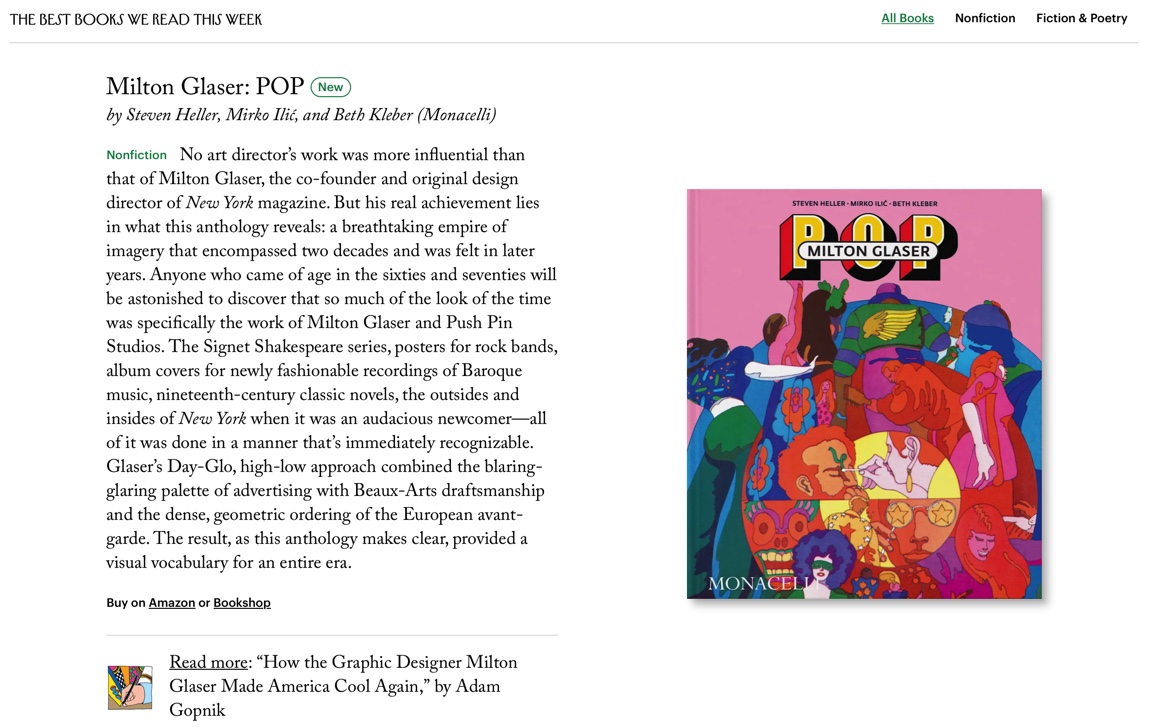
The show is based on the Milton Glaser: POP book published by Monacelli Press and written by Steven Heller, Beth Kleber and I. 


Thursday, March 30, 2023

The Best Books We Read This Week – New Yorker

'No art director’s work was more influential than that of Milton Glaser, the co-founder and original design director of New York magazine. But his real achievement lies in what this anthology reveals: a breathtaking empire of imagery that encompassed two decades and was felt in later years.' – New Yorker

More here.


Wednesday, March 22, 2023

"Milton Glaser: POP" in The New Yorker

A quote from the article, "How the Graphic Designer Milton Glaser Made America Cool Again" by Adam Gopnik in today’s The New Yorker.
 
'No art director’s work was more influential or instantly identifiable than that of Milton Glaser. The extent of that style, which adorned books and records and movies—and is revealed in a new anthology from Monacelli, courtesy of Steven Heller, Mirko Ilić, and Beth Kleber, titled simply “Milton Glaser: Pop”—is astounding. Glaser was famous as the co-founder and original design director of New York and as a creator of two images that helped define two decades. One was the 1966 poster of Bob Dylan that showed him with snakelike hair blossoming into a skein of rainbows. The other was the 1976 “I❤️NY” logo—which was commissioned by the State of New York but promptly adopted as a local symbol of the city, and, being keyed to the city’s unexpected revival, is the closest thing there has ever been to a logo that changed social history.'
 
'Of all the riches embedded in the Monacelli book, it may be the complete covers of the Signet Shakespeare, from around the same period as the Dylan poster, that are the most arresting. A central figure, usually enigmatically representative of the play’s action, appears in half-finished form, done in a charmingly elegant, linear style that recalls both Aubrey Beardsley and white-figure Greek vases; only a small patch of the drawing is in color, while the rest spins out like suggestive smoke. “Hamlet” is an agonized youth’s face, with a watching father’s head springing from his own and a barely suggested woman’s head—Ophelia?—alongside; “Julius Caesar,” memorably, is a tilting classical figure in profile, a zigzag of blue on a white implied toga to suggest greatness and a spot of pure red nearby to imply his stabbing. If you had no idea of what a play was about, none of these covers would tell you. Glaser relies on a general knowledge of the text—Hamlet is haunted, Julius Caesar is killed—and then suggests with his cryptic images that this story is more interesting and somehow more contemporary than one might have thought. The covers were less illustrations of the plays than they were invitations to read them.'